
How Heterogeneous Computing Architecture Is Redefining Industrial Site Security, AI Inference at the Edge, and Embedded Vision for Factories, Warehouses, and Operational Facilities
The convergence of artificial intelligence, FPGA-based adaptive computing, and x86 processing performance has created a new class of embedded solutions capable of transforming physical security at industrial and commercial sites. The AMD Embedded+ platform sits at the center of this transformation, delivering a unified hardware-software architecture that enables AI-based image recognition, real-time intrusion detection, and intelligent object classification at the edge — without relying on cloud connectivity or centralized data centers.
This article provides a thorough technical and strategic analysis of the AMD Embedded+ architecture, its core components, the Fujisoft AI-enhanced site security implementation, the comparative advantages over legacy frame-differencing systems, deployment methodology, and the broader industry trends that make heterogeneous embedded AI the definitive direction for next-generation physical security.
THE PROBLEM WITH CONVENTIONAL SITE SECURITY SYSTEMS
Legacy physical security systems deployed across factories, logistics warehouses, construction sites, and commercial facilities have historically relied on frame-to-frame pixel difference analysis as the primary method of motion detection. While computationally inexpensive, this approach introduces a cascade of operational failure modes that grow more severe as deployment environments become more complex.
Environmental False Positives Are Structurally Inevitable in Frame-Differencing Systems
Frame-differencing computes the absolute difference between consecutive video frames and flags pixels that exceed a brightness change threshold. In a controlled, static indoor environment under consistent lighting, this approach performs adequately. However, real-world industrial environments expose four categories of failure that make frame-differencing operationally unreliable:
- Lighting condition changes: Natural light shifting through skylights, LED fixture cycling, and emergency lighting transitions all generate pixel-level changes that are indistinguishable from motion to a frame-differencing algorithm.
- Weather and atmospheric effects: Rain streaks on exterior cameras, fog, and rapid cloud-induced contrast shifts produce sustained false-positive streams that overwhelm alert management systems.
- Vegetation and background motion: Branches, foliage, banners, curtains, and other objects that move continuously in ambient airflow create persistent false detections that require operators to manually suppress entire camera zones.
- Shadow movement: As lighting sources shift — sun angle, vehicle headlights, overhead crane movement — shadow boundaries move across the scene in ways that register as high-magnitude pixel changes.
The cumulative result is alert fatigue. Security operators habituated to high volumes of spurious alerts begin ignoring or suppressing notifications, which creates precisely the vulnerability that security systems are designed to prevent.
The Reconfiguration Burden in Traditional Perimeter Detection
Perimeter-based detection in conventional systems requires operators to manually draw detection polygons within camera software interfaces and calibrate sensitivity thresholds per zone. In facilities where operational layouts shift frequently — logistics centers reconfiguring pick paths, manufacturing floors reorganizing production cells — this reconfiguration burden generates recurring administrative overhead and creates windows during which zones are misconfigured or unmonitored.
AI-based detection eliminates this dependency on manually defined geometric zones by replacing zone-boundary logic with semantic classification: the system detects whether a recognized object category (a person, a vehicle, specific equipment) is present within the camera’s field of view, regardless of where within the frame that presence occurs.
AMD EMBEDDED+ ARCHITECTURE: UNIFIED HETEROGENEOUS COMPUTING
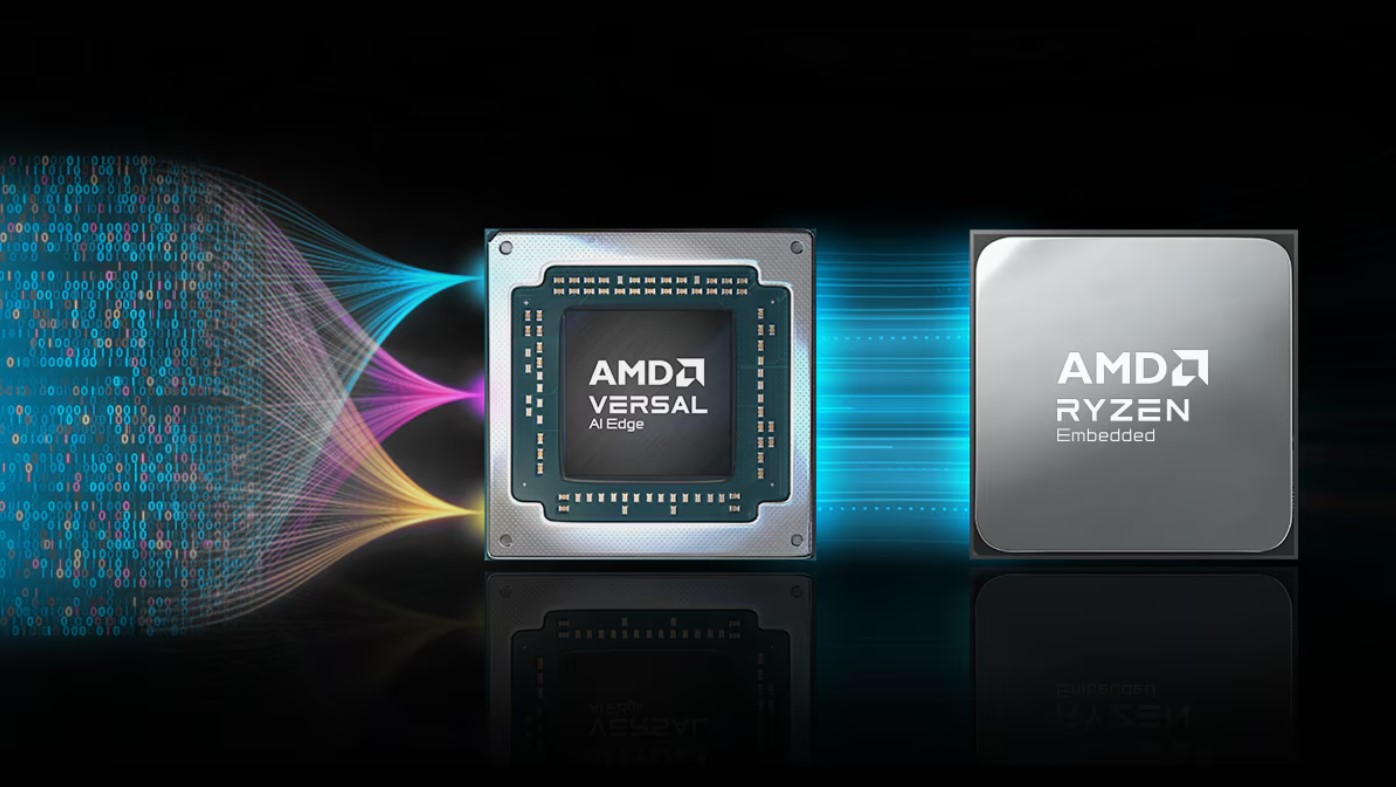
The AMD Embedded+ platform addresses the hardware requirements of AI-at-the-edge applications by co-integrating two fundamentally different processor architectures on a single printed circuit board — the AMD Ryzen Embedded processor and the AMD Versal adaptive System-on-Chip (SoC) — alongside a unified software development ecosystem.
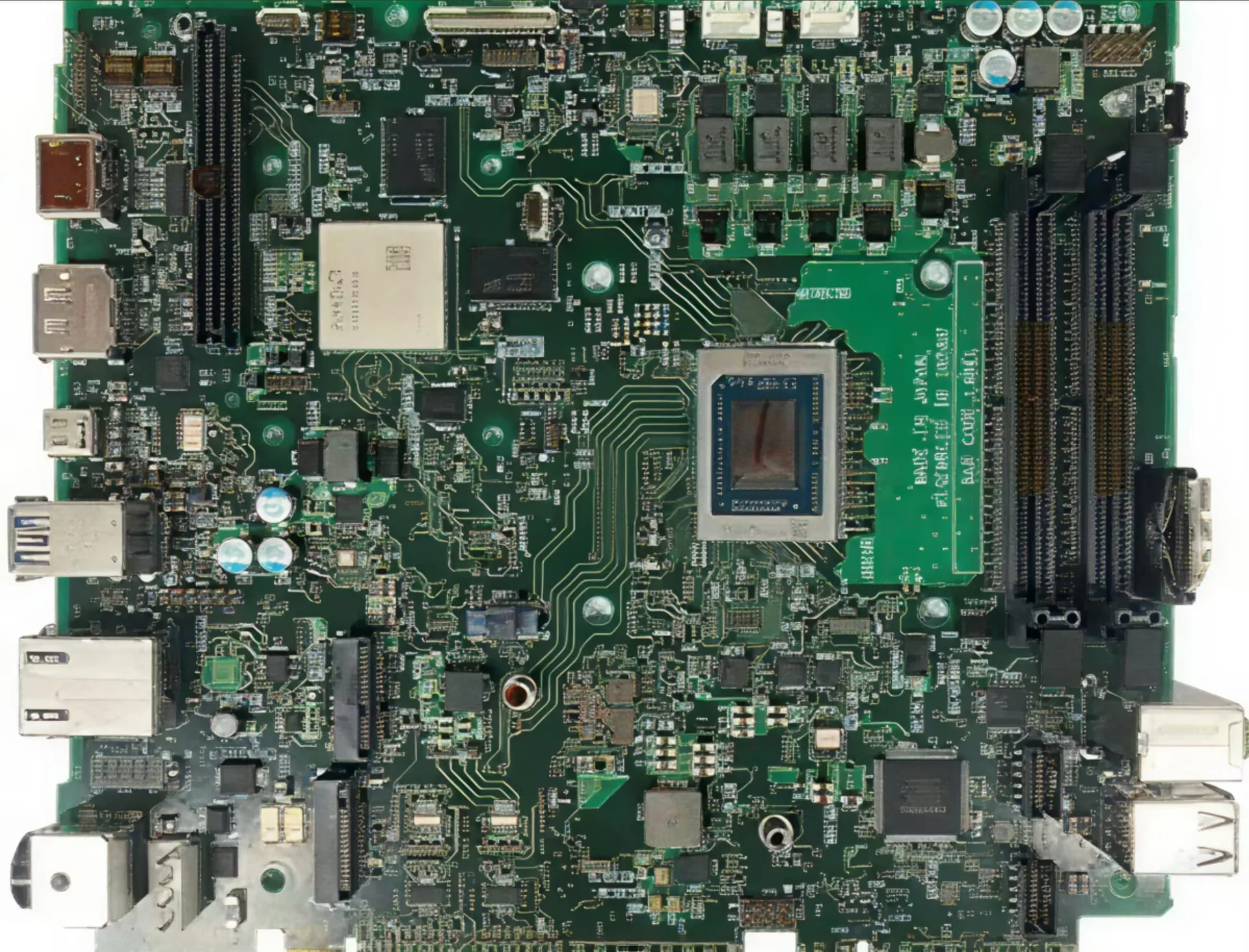
AMD Ryzen Embedded Processor: x86 Performance With Industrial-Grade Reliability
The AMD Ryzen Embedded processor provides the x86 compute substrate for the Embedded+ platform. The Ryzen Embedded product family is engineered for extended availability cycles suited to industrial applications, where product design cycles span years and replacement supply chain continuity is a primary procurement consideration.
- Multi-core Zen architecture: Multiple high-performance cores operating at frequencies suited to the real-time scheduling demands of video capture, pre-processing pipelines, and alert management software.
- Integrated memory controller: Support for DDR5 or LPDDR5 memory with ECC options, critical for operational resilience in unattended embedded deployments.
- PCIe connectivity: High-bandwidth lanes for interfacing with the Versal adaptive SoC and peripheral I/O expansion.
- x86 instruction set compatibility: Enables direct use of Linux-based operating systems, standard application frameworks, and the full AMD Ryzen AI Software stack without architectural porting overhead.
AMD Versal Adaptive SoC: Programmable Silicon for Real-Time AI Inference
The Versal adaptive SoC component provides the programmable hardware substrate that makes real-time, low-latency AI inference at the edge achievable without GPU-class power envelopes. Versal integrates several distinct compute domains on a single die:
- AI Engine (AIE) array: A spatially programmable vector processor array optimized for the matrix multiplication and convolution operations that dominate neural network inference workloads. The AIE architecture provides deterministic latency, essential for time-critical safety applications.
- Programmable Logic (PL): The FPGA fabric within Versal enables custom hardware pipelines for sensor preprocessing, protocol adaptation, and signal conditioning. In a multi-camera security deployment, PL can implement parallel video decode pipelines, image normalization accelerators, and custom I/O protocol bridges simultaneously.
- Processing System (PS): ARM Cortex-A class processors embedded within Versal provide a secondary compute domain for firmware, control plane logic, and lightweight software tasks.
- High-Speed Serial Connectivity: Integrated SerDes transceivers support PCIe Gen 4, Ethernet, and camera interface standards such as MIPI CSI-2, enabling direct connection to industrial IP cameras, thermal sensors, and LiDAR units.
Why This Matters
The combination of AIE, PL, and PS within a single Versal device gives the system the ability to perform image capture, preprocessing, neural network inference, and result postprocessing in a tightly coupled pipeline with minimal data movement overhead — a critical performance advantage over disaggregated architectures that rely on PCIe transfers between separate CPU, GPU, and FPGA components.
Vitis AI and Ryzen AI Software: End-to-End AI Development
The software ecosystem is as significant as the hardware architecture for production AI security deployments. AMD Vitis AI provides a complete development framework:
- Model quantization and compilation: Tools for quantizing floating-point trained models (PyTorch, TensorFlow, ONNX) to INT8 or mixed-precision formats, preserving detection accuracy while dramatically reducing inference compute requirements.
- Runtime libraries: The Vitis AI Runtime (VART) provides C++ and Python APIs for integrating AI inference into application software.
- Pre-optimized model zoo: AMD maintains a library of pre-validated, production-ready models for object detection, classification, semantic segmentation, and pose estimation.
AMD Ryzen AI Software extends AI acceleration capabilities to the Ryzen Embedded processor’s integrated NPU, enabling a dual-inference path where lightweight models run on the NPU and complex models execute on the Versal AIE array, with task scheduling managed transparently by the runtime.
FUJISOFT AI-ENHANCED SITE SECURITY SYSTEM
Fujisoft developed an AI-based physical security system built on the AMD Embedded+ platform, integrating FPGA adaptability with x86 processing performance in a unified architecture. The demonstration unit was completed in 2025, with the company now refining the solution for broader deployment.
AI-Based Person and Object Detection
The Fujisoft system replaces frame-differencing with a neural network inference pipeline that performs semantic object detection on each video frame, classifying regions of the image as containing persons, vehicles, or other defined object categories.
The object detection model runs on the Versal AI Engine. Each camera feed is decoded, preprocessed to the model’s input resolution, and submitted to the AIE array for forward pass computation. The model produces bounding box predictions with associated class probabilities and confidence scores. Post-processing logic filters predictions by confidence threshold and applies non-maximum suppression to produce a clean set of detected objects per frame.
Because the detection decision is based on recognized object semantics rather than pixel-level change magnitude, environmental motion that does not correspond to a recognized object category — a swaying branch, a shifting shadow, rain streaks — produces no detection output. False positive rates drop substantially compared to legacy frame-differencing.
Automatic Detection Area Configuration Using Stop Sign Fiducial Markers
One of the system’s most distinctive features is its intuitive area configuration method. The detection area is automatically configured by detecting four stop signs, allowing users to define the target area simply by placing stop signs in the desired locations.
This fiducial-marker-based zone definition method eliminates the need for camera software configuration interfaces. The workflow operates as follows:
- An operator places four physical stop signs at the corners of the intended detection perimeter within the camera’s field of view.
- The AI inference pipeline detects and localizes the four stop signs using a dedicated object detection class.
- The system computes a homographic transform from the detected marker positions to define the target detection polygon in image coordinates.
- Subsequent intrusion detection inference is applied specifically to the computed zone, with detections outside the boundary suppressed.
Practical Advantage
This approach is particularly well-suited to facilities where production floor layouts change frequently and security configuration by non-specialist workers is a practical requirement. Stop signs — a universally recognizable, high-contrast visual marker — provide reliable detection across varying illumination conditions and camera angles without requiring custom proprietary hardware.
Real-Time Monitoring, Alert Generation, and Response Pipeline
- Continuous inference loop: The Versal AI Engine processes camera frames at rates sufficient to ensure that a detected intrusion generates an alert within seconds of occurrence.
- Immediate visual and audible alerts: Upon detection of a person or classified object within the defined zone, the system triggers visual indicators and activates audible alerting equipment.
- Alert logging and timestamping: All detection events are logged with frame timestamps and detection confidence metadata for post-incident review.
- Network communication: Alert events are transmitted over the facility network to central monitoring stations or remote security operations centers.
COMPARATIVE ADVANTAGE: AMD EMBEDDED+ VS. COMPETING ARCHITECTURES
Versus Discrete CPU + GPU Architectures
- Power envelope: Discrete GPU-based edge AI systems typically consume 50–150W or more at the GPU alone, requiring active thermal management that increases system volume, cost, and failure surface area.
- Board area and form factor: Two separate silicon components with independent memory subsystems require significantly larger PCBs, limiting deployment in compact mounting configurations.
- Latency through PCIe: GPU inference requires copying preprocessed frame data across PCIe to GPU VRAM before inference can begin, adding latency and memory bandwidth overhead.
- Software complexity: Maintaining a stable CUDA or ROCm driver stack alongside FPGA control software introduces dependency management complexity.
The AMD Embedded+ platform’s co-integration of Ryzen and Versal on a single PCB eliminates the PCIe transfer latency, reduces total board area, and consolidates the driver and runtime stack.
Versus GPU-Based Edge AI Appliances (NVIDIA Jetson and Equivalents)
- Programmable I/O flexibility: Versal’s FPGA fabric enables custom sensor protocols, legacy analog camera adapters, and industrial bus interfaces (EtherCAT, Profinet) that require external hardware on Jetson platforms.
- Long-term supply availability: AMD Embedded+ products are designed for extended availability lifecycles aligned with industrial procurement requirements.
- Deterministic latency: The Versal AI Engine provides deterministic inference latency — a fixed, predictable time per inference pass — whereas GPU inference latency varies with memory state, power management, and concurrent workload. For safety-critical applications where alert latency SLAs must be guaranteed, deterministic inference is architecturally superior.
KEY SPECIFICATIONS SUMMARY
| Attribute | AMD Embedded+ Platform |
|---|---|
| Processor Architecture | AMD Ryzen Embedded (x86, Zen) + AMD Versal Adaptive SoC |
| AI Inference Engine | Versal AI Engine (AIE) Array — vector SIMD, deterministic latency |
| Programmable Logic | Versal FPGA Fabric — custom I/O, sensor preprocessing pipelines |
| Software Framework | Vitis AI, Ryzen AI Software, Vitis HLS |
| OS Support | Linux (x86), PetaLinux (Versal PS) |
| Camera Interface | MIPI CSI-2, GigE Vision (via PL), USB3 |
| Temperature Range | Extended industrial range (−40°C to +85°C) |
| Form Factor | Single PCB (co-integrated Ryzen + Versal) |
| Key Use Cases | AI security, industrial vision, edge inference, adaptive I/O |
DEPLOYMENT CONSIDERATIONS
Environmental Hardening and Industrial Qualification
Production deployment in factories, warehouses, and outdoor operational sites requires the embedded hardware to operate reliably across extended temperature ranges, in environments with particulate contamination, and under continuous 24/7 power-on conditions. The AMD Embedded+ platform supports operation across the extended temperature range (−40°C to +85°C junction temperature for qualified variants), enabling deployment in unheated outdoor enclosures, cold storage facilities, and high-temperature manufacturing environments.
Network Architecture and Cybersecurity
- Network segmentation: Security camera networks should be isolated from facility OT and IT networks using VLAN segmentation or dedicated physical infrastructure.
- Encrypted communications: All alert traffic should use TLS 1.3 encryption with certificate-based mutual authentication.
- Secure boot and firmware integrity: The AMD Versal supports hardware root-of-trust mechanisms, including eFUSE-based device identity and authenticated bitstream loading.
- Minimal attack surface: The Ryzen Embedded Linux environment should run a minimally configured OS image with only required packages and services.
Scalability: Multi-Zone, Multi-Camera, Multi-Site
The architecture is designed for scalability across facility size and camera density. A single Embedded+ board can process inference from multiple camera feeds simultaneously. For large facilities, a hierarchical architecture enables:
- Edge nodes: Individual Embedded+ units cover camera clusters within a defined facility zone, performing local inference and generating zone-level alerts.
- Aggregation layer: A central facility server aggregates alerts from all edge nodes and provides a unified operator dashboard.
- Central operations center: For multi-facility deployments, alerts from all aggregation servers are forwarded to a central security operations center for enterprise-wide situational awareness.
THE BOTTOM LINE
The architectural combination that AMD Embedded+ delivers — x86 processing performance from Ryzen Embedded, AI inference acceleration from the Versal AI Engine, programmable sensor I/O from Versal’s FPGA fabric, and a unified software ecosystem spanning Vitis AI and Ryzen AI Software — addresses every layer of the engineering challenge in building production AI-based physical security systems.
Fujisoft’s implementation demonstrates the concrete system-level outcomes: AI-based person and object detection that eliminates the false-positive burden of frame-differencing systems, automatic detection zone configuration via fiducial markers, and real-time alert generation with sub-second latency.
For system integrators, embedded solution developers, and industrial facility operators evaluating AI-based physical security platforms, the AMD Embedded+ architecture represents the convergence point of programmability, AI inference performance, software ecosystem maturity, and industrial supply chain reliability that production deployment demands.
BUILD WITH AMD TECHNOLOGY
Our custom builds feature AMD Ryzen processors — the same Zen architecture that powers the Embedded+ platform. Configure your AMD-powered gaming rig today.
VIEW ALL BUILDS BUILD YOUR OWN